
Houston proudly calls itself the Bayou City.
It’s on t-shirts, tourism materials, and civic branding. We celebrate Buffalo Bayou Park, run and bike along the trails, and use the waterways as landmarks when we give directions. But for a city defined by its bayous, we spend surprisingly little time actually appreciating them.
For most of the twentieth century, Houston treated its bayous as drainage infrastructure and nothing more. Their job was to move water away from homes, businesses, and streets as fast as possible. As the region grew, we straightened them, widened them, deepened them, and in many places poured concrete down their banks to speed the water along.
Those decisions reflected the priorities and the engineering knowledge of their time. Flood protection mattered then. It matters now. But something real was lost in the trade.
How Houston Buried Its Bayous
More than a century ago, in 1913, landscape architect Arthur Comey told Houston that its bayous were the backbone of a future park system. He imagined a region where the waterways connected neighborhoods, parks, and public spaces. Where the city faced its bayous instead of turning away from them.
We chose a different path. It took a world war, a depression, another world war, and the Federal Highway Act to bury that idea under concrete and asphalt. Development turned its back on the water. Back fences faced the bayous. Roads crossed over them. Entire generations of Houstonians grew up thinking of a bayou as a drainage ditch rather than an ecosystem.
White Oak Bayou is one of the clearest examples. The U.S. Army Corps of Engineers channelized a long stretch of it between 1964 and 1971, around the same time I-10 went in alongside it. The meanders went away. The concrete came in.


How Houston forgot its bayous — and started to remember them
In 1913, landscape architect Arthur Comey told Houston that its bayous were the backbone of a future park system. It took a world war, a depression, another world war, and the Federal Highway Act to bury that idea under concrete and asphalt. It took the Buffalo Bayou Partnership, $220 million in public and private investment, and 29 years to begin bringing it back. White Oak Bayou is next.
Fortunately, not everyone accepted that future.
One of the most influential voices was Terry Hershey, whose advocacy helped stop Buffalo Bayou from being turned into a fully channelized flood-control corridor. Her work preserved one of Houston’s most important natural landscapes — and proved that environmental stewardship and flood management don’t have to be enemies.
What We Know Now That We Didn’t Then
Our understanding of stormwater has changed a lot since the concrete went in.
We now know that rushing water off the land as fast as possible isn’t always the smartest strategy. Rain gardens, bioswales, detention basins, restored wetlands, permeable surfaces, and other forms of green infrastructure can slow, store, and filter stormwater before it ever reaches the bayou. Parks can double as flood infrastructure. Natural systems can build resilience and give people somewhere to be.
We’ve also come to appreciate what a living waterway is worth. Healthy bayous support birds, fish, turtles, pollinators, and countless other species. They clean water, provide habitat, and let people experience nature in the middle of a major American city.
The question is whether we’re willing to apply those lessons to the bayous we already paved.
Other Cities Took the Concrete Out and It Worked
This isn’t a thought experiment. Cities across the country and around the world have already pulled concrete out of their rivers, and the results are in.
San Antonio: Mission Reach
Two hundred miles down I-10, San Antonio did exactly what we’re talking about. The Mission Reach project restored an eight-mile stretch of the San Antonio River that had been straightened into a flood-control ditch. Removing the hard channel, putting the river’s natural curves back, rebuilding aquatic habitat, and planting more than 20,000 native trees and shrubs. It was the centerpiece of a roughly $384 million river improvements program and is now considered the largest urban ecosystem restoration in the country.
The part Houston should pay attention to: it was designed to still carry a major flood. San Antonio didn’t trade flood protection for nature. They got both — plus miles of trail and millions of visitors. The river works better as a river than it did as a ditch.
Seoul: Cheonggyecheon
Seoul went further. A buried stream called Cheonggyecheon had been entombed under a six-lane elevated freeway carrying around 170,000 cars a day. In 2003, the city tore the freeway down and brought the stream back to the surface, creating a 3.6-mile green corridor through the center of downtown.
The traffic apocalypse everyone predicted never came. What did come was a measurably cooler corridor — the restored stream runs several degrees cooler than the surrounding concrete city — along with a surge of new businesses and foot traffic and a global reputation as the model for this kind of work. Seoul took out a highway and the city got better.
Florida: The Kissimmee River
And then there’s the example that should end the argument. In the 1960s, the same agency that channelized White Oak Bayou — the U.S. Army Corps of Engineers — turned Florida’s meandering Kissimmee River into a straight 56-mile canal for flood control. Within a few years, waterfowl populations had crashed by 90 percent and bald eagle numbers by 70 percent.
So the Corps reversed itself. Beginning in the 1990s and finishing in 2021, the Corps and its partners backfilled the canal they had dug, reconnected 44 miles of the historic river channel, and brought back roughly 40 square miles of floodplain wetlands. It is now the largest river restoration in the world, and the wildlife came back.
Read that again: the agency that built the ditch decided the ditch was the wrong answer and spent two decades undoing it. White Oak Bayou was channelized in the same era, by the same agency, for the same reasons.
The Case for White Oak Bayou Restoration
We don’t have to imagine what restoration could look like here, either… Houston has already studied it.
In 2017, the Memorial Heights Redevelopment Authority funded a study of alternatives to simply replacing the aging concrete lining along a section of White Oak Bayou north of downtown. Instead of automatically rebuilding the channel, the study asked what restoration might offer.
The findings were striking. Researchers identified real opportunities to remove concrete, expand habitat, add recreational space, improve water quality, and even build in regional stormwater detention — all while maintaining flood protection. The more ambitious concepts envisioned dozens of acres of restored habitat and hundreds of acre-feet of new stormwater storage.
The study hasn’t advanced into a funded project. Restoration takes investment, engineering, and public will. But here’s the decision Houston is going to face whether we plan for it or not: concrete channels don’t last forever. When this lining reaches the end of its useful life, we’ll have a choice. Rebuild the ditch exactly as it was — or build something better.
San Antonio, Seoul, and the Army Corps in Florida all faced that same fork. They chose to restore.
What Naturalizing the Bayou Would Give Us Back
So what does Houston actually get if we take some of the concrete out? More than most people expect.
A place worth looking at. A naturalized bayou — meanders, native banks, shade, birdsong — is simply a more beautiful piece of the city than a concrete trench. Beauty isn’t a luxury here; it’s what makes people show up, slow down, and care about a place enough to protect it.
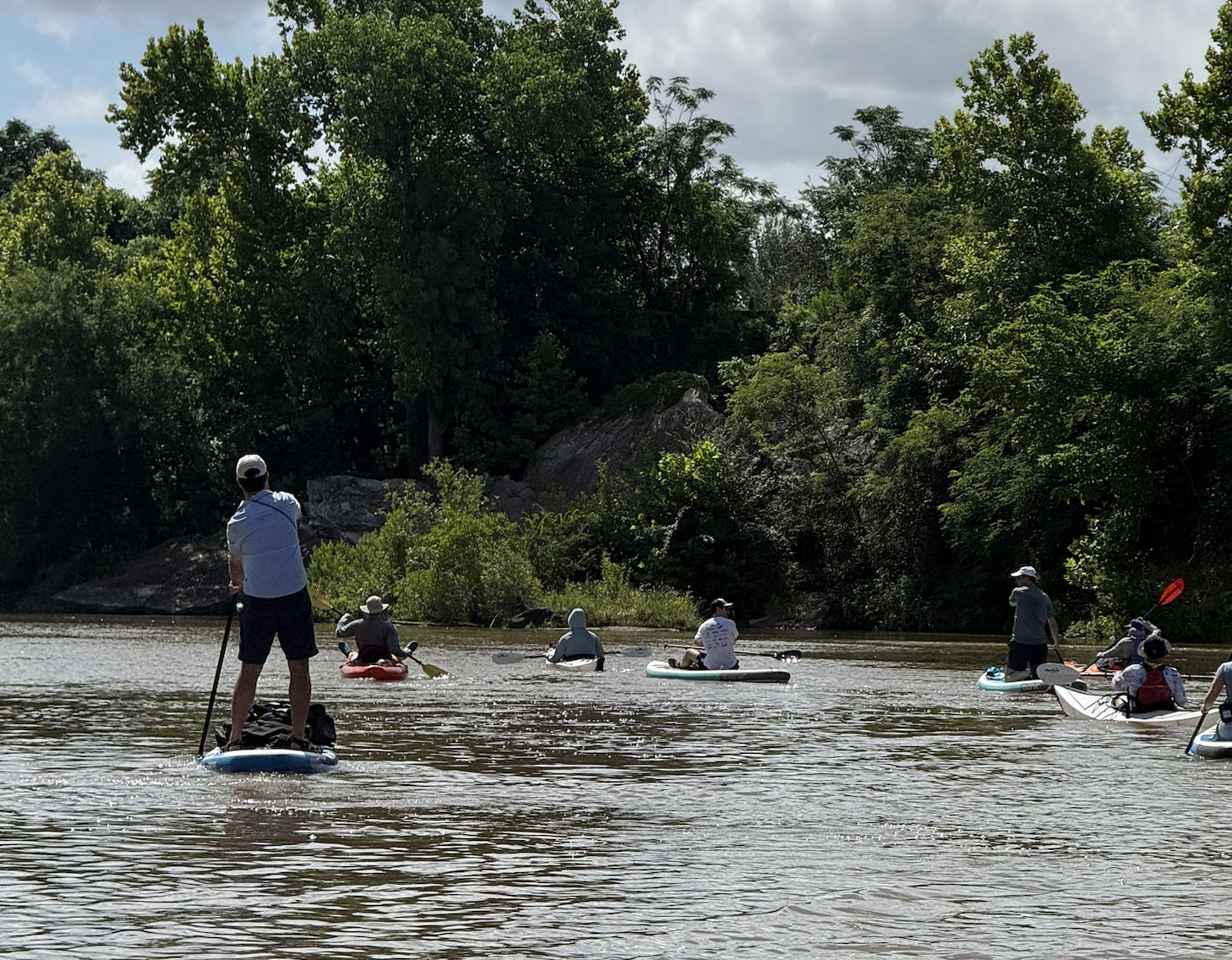
Somewhere to get on the water. Houston already has a quiet paddling culture, and our bayous offer a side of the city you can’t see from the street — one minute you’re surrounded by nature, the next you’re drifting under a freeway with a skyline view. Restored, slower-moving stretches make kayaking, paddling, and riverside recreation safer and far more inviting.
Cleaner water and real habitat. Naturalized banks, wetlands, and floodplain plantings filter pollutants before they hit the bayou and rebuild the habitat that birds, fish, turtles, and pollinators need. A living corridor does ecological work a concrete chute never can.
A cooler neighborhood. Concrete is a heat sink — it bakes all day and radiates that heat back into the surrounding blocks. Trees, water, and vegetated banks do the opposite. Seoul’s restored stream measurably cooled the corridor around it, and in a city like ours, where summer heat is a genuine public-health issue, a cooler bayou is a tangible win.
More canopy. Restoration means trees — thousands of them — exactly the kind of work our SHADE program already does block by block. A naturalized bayou is a continuous green spine where that canopy can connect, mature, and do the most good: shade over trails, roots holding banks, leaves cooling the air.
None of this requires giving up flood protection. Every project above kept it. The lesson from all of them is the same — done right, a restored waterway protects people better, not worse, while giving the city back something it gave away decades ago.

Our bayous offer a side of Houston hidden from ground level. One minute you’re surrounded by nature, the next, you’re drifting beneath gigantic highways with unique views of Downtown.
Join Bayou enthusiasts with an eye opening perspective of Houston from the water.
It’s Time to Start Acting Like a Bayou City
We talk endlessly about roads, freeways, and development. We debate parks, housing, and transit. But our waterways too often stay an afterthought… even though they’re among the defining features of this region.
The future of Houston will always be shaped by water. The only question is whether we keep treating our bayous as infrastructure to be managed, or start seeing them as assets worth restoring, stewarding, and showing off.
Other cities already answered that question. So did the Army Corps, in Florida, with the same kind of channel we’re living with here.
It’s time to start acting like a Bayou City.
Want to help make Houston more walkable, connected, and green? Get involved with A Tale of Two Bridges.


Leave a Reply